
 中文
 English



TD200S Series Inverter Application in Plastic Extrusion Machines
I. Introduction
There are various types and specifications of extrusion machines, the most common being screw extrusion machines. The plastic is melted in the extrusion machine and then continuously extruded through the die head under constant temperature, quantitative, and pressure control. The specific model can be seen in Figure 1. The rotational speed of the screw directly determines the production efficiency and quality, and the stability of the rotational speed is very high. At the same time, when the extrusion machine starts, the resistance is very high, which requires the motor to be able to output sufficient torque at low frequencies. Permanent magnet synchronous motors have high operating efficiency and power factor, and have high speed control accuracy, large speed ratio, hard output characteristics, and stable operation. Therefore, permanent magnet synchronous motors are increasingly widely used in the extrusion system of extrusion machines.
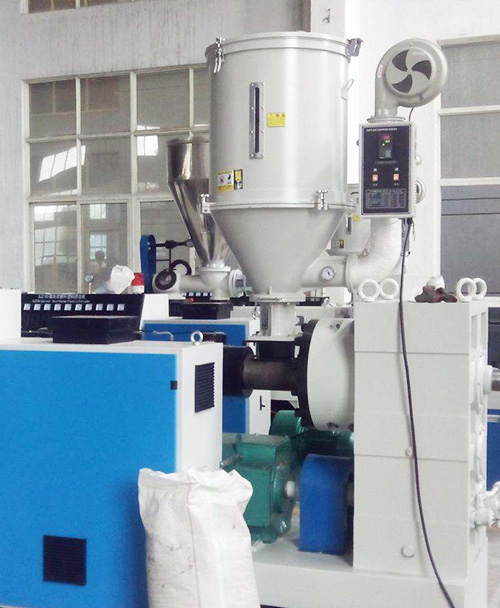
II. Introduction to TD200S Series Inverter
The TD200S series inverter is a high-performance open-loop vector inverter developed by Hisitech Electric. It has two control modes: V/F and no-PG vector. In the case of sudden load increase or decrease, the speed fluctuation is very slight. It can support permanent magnet synchronous motors and inverter motors. It supports rotational self-learning and static self-learning. Static self-learning can accurately learn the parameters of the motor in cases where the motor cannot be decoupled from the load. It has an advanced full-phase modulation method, making the motor run more smoothly and with less noise.
III. On-site Motor Parameters, Characteristics, and User Requirements
The dedicated motor for the extrusion machine on site is a permanent magnet synchronous motor with a capacity of 30kW, 15 pairs of poles, a hidden-pole type, a rated frequency of 15Hz, a rated voltage of 380V, a rated current of 49A, and a rated speed of 60r/m. The user has external loading equipment and can load the permanent magnet synchronous motor with variable loads.
User Requirements: Static self-learning of parameters; Open-loop control without encoder; The motor can output twice the torque at frequencies below 3Hz; No out-of-step situation during operation; The ability to read inverter data and display current, speed, and voltage waveforms.
The user has previously tried other inverter products from domestic and foreign companies, but they did not meet the customer's requirements. The main reason was that the motor could not start at low frequencies and high loads in open-loop mode. Secondly, during operation, there would be out-of-step situations.
IV. Debugging Results
After the self-learning is completed, the inverter is run. The following steps are carried out for debugging:
At a frequency of 15Hz, add 100% load, start, stop, and add or subtract smoothly, with normal current waveforms and a power factor of 0.98.
At a frequency of 10Hz, add 150% load, with normal current waveforms.
At a frequency of 7.5Hz, add 200% load, with normal current waveforms.
Increase the motor's operating speed to the maximum of 100r/m to test the extreme characteristics of the motor. The current waveforms are normal.
Increase the motor load to 1.7 times and 2 times respectively, and start and stop at low frequencies below 3Hz. The inverter output current waveforms are normal.
Through on-site debugging, the user is very satisfied with the above debugging results.
