
 中文
 English



Application of TD100 Series Frequency Converters in Rewinding and Cutting Machines
Introduction:
The rewinding and cutting machine is a piece of equipment that takes the rolled raw paper and through rewinding and cutting, combines various widths of single-layer raw paper into multi-layer paper products while simultaneously cutting them into different widths of semi-finished paper products for the next process. The structure of the rewinding and cutting machine is divided into the front rewinding, upper and lower calendering (depending on the customer's requirements, some models have upper and lower embossing rollers), the rear frame 1, rear frame 2, rear frame 3, rear frame 4... etc. The number of rear frames can be added or reduced according to the user's requirements. Its working process is that the rear frame guide paper rollers pull the plain paper to the calendering or embossing and combine it into multi-layer raw paper - cutting - rolling to a certain required diameter and then stops to unwind the paper - moving to the next process.
The process requirements of the rewinding and cutting machine:
The process flow of the rewinding and cutting machine is divided into four to five parts: unwinding - calendering (embossing) - cutting - rolling.
In the rolling part, the front and rear unwinding rollers are driven by independent motors and roll up the raw paper through the friction between the raw paper and the front and rear unwinding rollers. The unwinding frame is also unwound through belt friction. The characteristic of this unwinding and rewinding is that no complex roll diameter calculation is required. As long as the line speeds of the rolling and unwinding are the same at high and low speeds, the tension of the paper can be the same. This requires a very high speed following ability between the motors, otherwise, the paper will break, causing the production to stop. Re-winding the paper will waste a lot of manpower and time, and also waste raw materials, increasing production costs.
It is required that there will be no paper breakage in various stop modes, such as deceleration stop, emergency stop, power failure, etc.
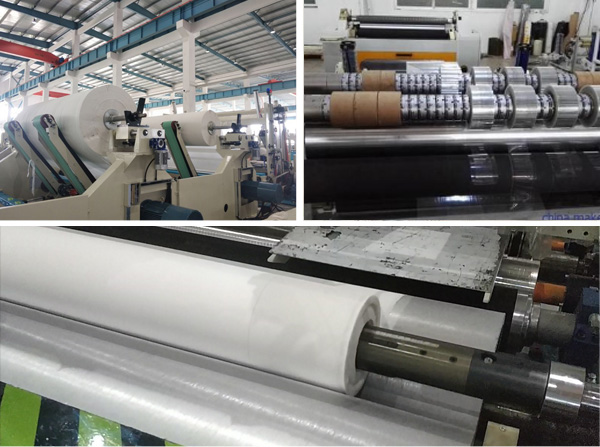
Solution Description:
The post-coiling frequency converter serves as the main unit, and the operating frequency is set by the PLC analog module. The operating signal is set by the PLC digital module.
The rewinding drive frequency converter serves as the main unit, and the original paper drive frequency converter is the slave unit. The operating signal is set by the PLC digital module. Among them, the original paper drive frequency converter is for position control, and the position signal is controlled by the frequency division output of the rewinding drive frequency converter. The electronic gear ratio of each slave unit is set on the touch screen, and the speed ratios of each part can be adjusted on the touch screen.
